Monday, September 13, 2010

2011 Jeep Patriot


Chrysler has just revealed the first images and details of its 2011 Jeep Patriot, and the compact softroader has received very subtle nip/tuck for the new model year that touch nearly every aspect of the vehicle.

Exterior upgrades include what Chrysler describes as a more "aggressive" front fascia with standard foglamps, a new rear fascia, body-color grille and optional 17-inch wheels. The SUV also gets four new exterior colors, as well as an increased 4x4 ride height. "Ride and handling is refined courtesy of returned steering and suspension systems," said Chrysler in a statement, although specific details are not being disclosed yet.

At the interior the automaker has increased the quality of materials, and the steering wheel integrates the audio/trip controls just like in the new Grand Cherokee.

The 2011 Jeep Patriot will be offered with front-wheel- or four-wheel-drive, and will be available in three configurations – Sport, Latitude and Latitude X. Sales will begin in the fourth quarter of 2010.

Other top features are the 2011 Jeep Patriot model's affordability, fuel economy for its segment and safety features, Chrysler said. (The 2010 model took Top Safety Pick honors from the Insurance Institute for Highway Safety -- provided the vehicle has the optional side torso airbags). Chrysler hasn't announced pricing, but Edmunds experts expect that the base-model MSRP will be $17,795 and predict that fuel-economy will be a combined 25.


2011 Jeep Patriot2011 Jeep Patriot2011 Jeep Patriot2011 Jeep Patriot2011 Jeep Patriot2011 Jeep Patriot2011 Jeep Patriot2011 Jeep Patriot2011 Jeep Patriot2011 Jeep Patriot2011 Jeep Patriot2011 Jeep Patriot2011 Jeep Patriot2011 Jeep Patriot2011 Jeep Patriot2011 Jeep Patriot2011 Jeep Patriot2011 Jeep Patriot2011 Jeep Patriot2011 Jeep Patriot


Press Release

Coming Soon From Jeep®: 2011 Patriot with Aggressive New Styling, Segment- leading Capability and Unsurpassed 4x4 Fuel Economy


September 14, 2010 , Auburn Hills, Mich. - Chrysler Group LLC released images today of the new 2011 Jeep Patriot, the affordable compact sport utility vehicle (SUV) that offers consumers segment-leading capability and unsurpassed 4x4 fuel economy, along with classic, rugged Jeep styling.

Jeep Patriot's classic exterior styling and capability are enhanced for 2011 with new front and rear fascias, a body-color grille, and an increased 4x4 ride height. Ride-and-handling is refined courtesy of retuned steering and suspension systems. Interior enhancements round out the new-for-2011 features, and include significantly upgraded touch points.

"Patriot boasts class-leading 4x4 capability and unsurpassed fuel economy, and a host of safety features in a fun and affordable package – a combination that only Jeep can offer," said Mike Manley, President and CEO – Jeep Brand, Chrysler Group LLC. "For 2011, Jeep Patriot is even more appealing to consumers, thanks to rugged new exterior styling, interior enhancements and refinements to the suspension and steering systems."

New-for-2011 Jeep Patriot exterior highlights include an aggressive new front fascia with standard fog lamps positioned inside the headlamps; a new rear fascia that extends lower than on previous models; a body-color grille; new available 17-inch wheels; four new colors and 4x4 ride height that has been increased by 1 inch.

Interior upgrades for the 2011 Jeep Patriot include new soft touch front-door trim panels with a padded upper surface; new center armrest; a new Jeep steering wheel with integrated controls that allow the driver to operate the radio, cruise control, hands-free phone and other vehicle functions while keeping their hands on the wheel; new cloth interior, with premium cloth bucket seats in the front; standard speed control on all models; new backlighting of door switches, door locks, windows and power mirror controls and standard automatic temperature control on the Latitude X model.

Available as a stand-alone option on all models for 2011 is the Uconnect® Voice Command with Bluetooth for hands-free calling and music/radio/SIRIUS satellite radio control.

The 2011 Jeep Patriot offers customers more capability than any other vehicle in the compact SUV class. Capability features include low-range mode which generates a best-in-class 19:1 crawl ratio, brake traction control, 19-inch water fording capability, Hill Descent Control, 4x4 Lock shift-on-the-fly which sends 50 percent of torque to front and rear wheels, and a maximum tow rating of 2,000 lbs. The Jeep Patriot also boasts a retuned suspension for 2011, with higher spring and damping rates, added rebound springs, and an increased diameter of the rear sway bar. Despite these numerous capability features, the 2011 Jeep Patriot boasts unsurpassed 4x4 fuel economy in its segment.

A 2010 Insurance Institute for Highway Safety (IIHS) Top Safety Pick, the Jeep Patriot for 2011 is loaded with more than 30 standard safety and security features, thoughtful functionality and best-in-class off-road capability with Freedom Drive II, offering tremendous value for consumers that desire an SUV to accommodate their active lifestyle at an affordable price.

Offered with front-wheel- or four-wheel-drive, Jeep Patriot is available in three configurations – Sport, Latitude and Latitude X.

Built at the Belvidere Assembly Plant in Belvidere, Ill., the new 2011 Jeep Patriot models arrive in Jeep showrooms in the fourth quarter of 2010.

About Chrysler Group LLC
Chrysler Group LLC, formed in 2009 from a global strategic alliance with Fiat Group, produces Chrysler, Jeep®, Dodge, Ram Truck and Mopar® vehicles and products. With the resources, technology and worldwide distribution network required to compete on a global scale, the alliance builds on Chrysler's culture of innovation – first established by Walter P. Chrysler in 1925 – and Fiat's complementary technology – from a company whose heritage dates back to 1899.

Headquartered in Auburn Hills, Mich., Chrysler Group LLC's product lineup features some of the world's most recognizable vehicles, including the Chrysler 300, Jeep Wrangler and Ram Truck. Fiat will contribute world-class technology, platforms and powertrains for small- and medium-sized cars, allowing Chrysler Group to offer an expanded product line including environmentally friendly vehicles.

Tuesday, March 23, 2010

Chrysler to develop new Fiat 500 electric vehicle for U.S.

[Fiat+500+Electric+Vehicle-1.jpg]

Chrysler announced today that it will build an all-electric vehicle using the Fiat 500 platform. For those who don’t know the Fiat 500EV made its debut back in January at the 2010 Detroit Auto Show and the manufacturer promises that the vehicle will demonstrate the immediate benefits of the alliance between Chrysler Group and the Fiat Group.

The US edition will undergo further development at Chrysler hq in Auburn Hills, Michigan. "The alliance with Fiat presented new opportunities to merge Chrysler Group engineering knowledge with new platforms and the Fiat 500EV is an outstanding example of our efforts," said Chrysler engineering executive Scott Kunselman.

“The Fiat 500 is a small, lightweight platform perfect for integrating electric-vehicle technology.” added the same Kunselman.

Pricing for the Fiat 500EV will be “competitive with similar electric vehicles in the market.” Most automakers have all-electric vehicles planned over the next few years.


Fiat 500 Electric Vehicle Fiat 500 Electric Vehicle Fiat 500 Electric Vehicle Fiat 500 Electric Vehicle


Press Release

Chrysler Group LLC to Develop New Fiat 500 Electric Vehicle for the
United States
  • New Fiat 500EV demonstrates benefits of Chrysler Group and Fiat
    Group alliance
  • Zero-emission Fiat 500EV provides an environmentally friendly,
    clean, quiet driving experience freeing customers from escalating fuel
    costs and costly oil changes
  • Department of Energy provides up to $48 million grant toward test
    fleet of 140 Ram Plug-in Hybrid Electric Vehicles
  • PHEV technology to improve fuel economy up to 65 percent with up to
    20 mile electric-only driving range

Chrysler Group LLC today announced its plans to engineer and produce a
pure electric vehicle using the Fiat 500 platform. Shown earlier this year
at the 2010 North American International Auto Show, the Fiat 500EV
demonstrates the immediate benefits of the alliance between Chrysler Group
and the Fiat Group as well as the speed at which the two companies can work
together on advanced vehicle programs.

"The alliance with Fiat presented new opportunities to merge Chrysler
Group engineering knowledge with new platforms and the Fiat 500EV is an
outstanding example of our efforts," said Scott Kunselman, Senior Vice
President Engineering-Chrysler Group LLC. "The Fiat 500 is a small,
lightweight platform perfect for integrating electric-vehicle technology."

The Fiat 500EV powertrain is comprised of three main systems; high power
electric powertrain module, advance lithium ion battery, and an EV control
unit to manage power flows. Beginning in 2012, Chrysler Group will
manufacture the Fiat 500EV for the United States market. All powertrain
engineering and vehicle development will take place at Chrysler Group
headquarters in Auburn Hills, Mich. Pricing will be announced closer to
launch, but will be competitive with similar electric vehicles in the
market.

Chrysler Group is the vehicle electrification center of competence for
both Chrysler Group and Fiat Group. The company is exploring ways to promote
zero-emission transportation and the development of an electric-vehicle
charging infrastructure through partnerships to be announced in the future.

Last year Chrysler Group announced the company's intention to build the
Fiat 500 with a combustion engine for North America. The vehicle will debut
in late 2010.

Ram Plug-in Hybrid Electric Vehicle (PHEV)

Chrysler Group has been selected for a U.S. Department of Energy (DOE) grant
of up to $48 million as part of a $2.4 billion American Recovery and
Reinvestment Act DOE Vehicle Electrification program. Chrysler Group is
planning to build a total of 140 Ram PHEVs for a three-year demonstration
project that includes various geographic and climatic locations across the
United States.

"This initiative represents how government, automotive industry,
suppliers and key partners are reaching common goals and demonstrates how
rapidly this type of advanced technology can be brought to market," said
Paolo Ferrero, Senior Vice President-Powertrain, Chrysler Group LLC.
"DOE-support for domestic advanced technology is an important enabler for
Chrysler Group and its key suppliers in order to understand and test
customer acceptance and the capability of PHEV systems in a variety of
real-world conditions."

The Ram PHEV features Chrysler Group's 5.7-liter HEMI V-8 with a two mode
hybrid transmission and a 12KwHr lithium ion battery. The vehicle is capable
of up to 20 miles of zero-emission, pure-electric range without the need for
gasoline. An overall fuel economy improvement more than 65 percent is
expected for average drive cycles. Chrysler Group has partnered with
Electrovaya Inc. to supply the advanced lithium Ion batteries for the Ram
PHEV test fleet.

The DOE grant will expedite the development of vehicle-electrification
technology. More than 21 Chrysler Group partners across the U.S., including
utility companies, government agencies and Universities will independently
test the Ram PHEV and provide valuable data for the advancement of the
technology.

In 2008, Chrysler Group announced the company's intention to bring a Ram
Hybrid Electric Vehicle (HEV) to market. After closely evaluating the
response to hybrid pickups in the marketplace, the company could not
formulate an appropriate business case and has decided to cancel development
work on the 2011 Ram HEV.

Chrysler Group's alliance with Fiat Group brings new platforms and
technologies that allow the company to create an improved long-term product
strategy with greater fuel efficiency and reduced emissions. Chrysler
Group's five-year plan has an uncompromising product schedule, including a
progressive vehicle electrification strategy.


Friday, March 19, 2010

Chrysler kicks off prolongation of Pentastar V6 engine, before wellknown as “Legendarybird”

[Chrysler+Pentastar+V6+enters+production-1.jpg]

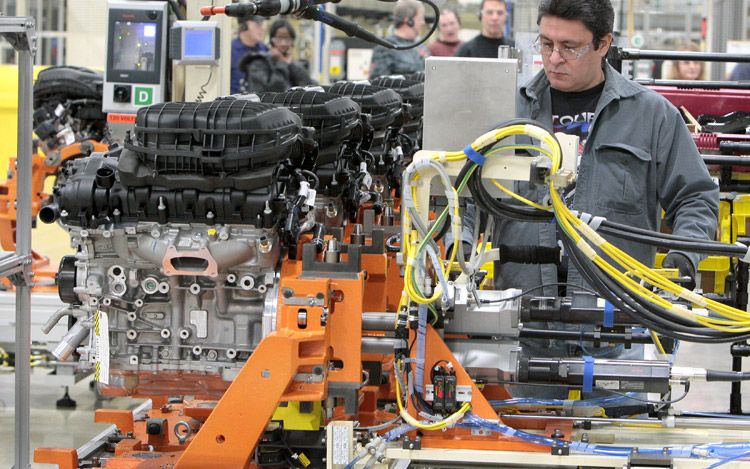
Chrysler launched production of its all-new 3.6-liter 'Pentastar' (Phoenix) V-6 engine today at its Trenton, Michigan South Engine Plant. Chrysler first introduced the engine at the New York Auto Show last year, announcing that it would launch in the all-new 2011 Jeep Grand Cherokee - a vehicle expected to hit showrooms in the second quarter of 2010. The engine will ultimately replace seven different V-6 engines currently in the Chrysler Group lineup, resulting in less-costly and more efficient engine production.

Design this all aluminum, 60-degree, dual-overhead cam (with non-static valve timing) powerplant to see lots of use in a near-term destiny – Chrysler boasts that the Pentastar V6 will replace 7 stream V6 engines. In the brand-new Grand Cherokee, a Pentastar will put out 280 horsepower The 22-percent enlarge during 6,400 rpm and 260 pound-feet of torque (an 11-percent alleviation at 4,800 rpm.

Just as importantly, Chrysler tells us that the newborn engine module be 11 proportionality more render economical than the organisation it replaces, and it module separate on either lawful 87-octane fuel or E85. This kinsfolk of engines equal a $730 meg investment, and the 822,000-square-foot Trenton artefact module be healthy to display more than 400,000 engines per year.

Chrysler Pentastar V6 enters Chrysler Pentastar V6 enters Chrysler Pentastar V6 enters Chrysler Pentastar V6 enters Chrysler Pentastar V6 enters Chrysler Pentastar V6 enters Chrysler Pentastar V6 enters


Press Release

Chrysler Group LLC Celebrates Production Launch of Pentastar V-6 Engine
at All-new Trenton, Mich., Facility
  • Governor, Wayne County Executive, Mayor and UAW join employees for
    celebration

  • All-new 3.6-liter Pentastar V-6 to replace seven current V-6 engines,
    resulting in flexibility, efficient operations and significant cost savings
    to the company

  • Michigan becomes center of Chrysler Group's powertrain offensive

  • Nearly $1 billion in powertrain investments in Michigan since 2007
Auburn Hills, Mich., Mar 19, 2010 - With Michigan Governor Jennifer M. Granholm
and other local officials in attendance, Chrysler Group LLC celebrated the
launch of its all-new Pentastar V-6 engine at an event today at the Trenton
(Mich.) South Engine Plant (TSEP).

In addition to the Governor, Wayne County Executive Robert Ficano, Trenton Mayor
Gerald Brown, UAW Chrysler Department Assistant Director Tim Bressler and other
local officials joined Chrysler Group executives and Trenton South employees in
recognizing the importance of the plant and the new engine in the future success
of the Company.

"The Pentastar engine is a cornerstone of Chrysler's efforts to re-invent its
business model with strong, brand-focused, world-class quality products," said
Scott Garberding, Head of Manufacturing, Chrysler Group LLC. "The new Trenton
South plant demonstrates the Chrysler Group's commitment to supporting economic
development in Michigan. It also acknowledges the support of the International
UAW and our outstanding workforce for helping us create an engine plant that can
compete with the best in the world. Their efforts will help establish Trenton
South as a premier manufacturer of fuel-efficient engines in support of the
Company's future growth."

Chrysler Group's all-new flex-fuel Pentastar V-6 is the most advanced V-6 engine
in the company's history. This new line of V-6 engines will contribute to an
overall fuel-efficiency improvement of more than 25 percent across the Chrysler,
Ram Truck, Jeep® and Dodge product lineup. More refined and fuel-efficient, the
Pentastar engine will ultimately replace seven current Chrysler Group V-6
engines and utilize advanced technologies from the Fiat alliance such as
Multiair, direct-injection and turbocharging.

The first application of this engine will be in the all-new 2011 Jeep Grand
Cherokee, due out in the second quarter this year.

The start of production at Trenton South represents one piece of the Chrysler
Group's revamped powertrain strategy. In December 2009, the Company announced
that it would invest $179 million in its Global Engine Manufacturing Alliance (GEMA)
plant in Dundee, Mich., to produce the 1.4-liter, 16-valve Fully Integrated
Robotized Engine (FIRE). Together, these two plants - with a combined investment
of nearly $1 billion - position Michigan at the center of Chrysler Group's
powertrain offensive.

"With the start of production here in Trenton and the recently announced
investment in Dundee, Chrysler Group has helped affirm Michigan's position as
the world's leader in automotive innovation and excellence," said Gov. Granholm.
"These projects further demonstrate that Michigan has the competitive business
climate, infrastructure and talented workforce to compete in the global
marketplace."

Chrysler Group announced a $730 million investment in the Pentastar program when
it broke ground on the all-new 822,000-square-foot facility in May 2007. The
plant will have an annual manufacturing capacity of more than 400,000 engines.

"Three years ago, Chrysler Group demonstrated its confidence in its workforce by
investing in its powertrain operations," said the UAW's Bressler. "Today, the
UAW members at Trenton are excited to participate in building the next
generation of high quality, fuel-efficient engines for Chrysler's great lineup
of vehicles and thereby, ensuring the Company's future success."

Friday, March 12, 2010

Dodge Ram Power Wagon Spy


We just told you that that Chrysler will be launching four new "Moparized" vehicles later this month, and our spies have already caught one of these new vehicles – the Dodge Ram Power Wagon – on the streets of southeast Michigan.


Unlike the Power Wagon that's just now hitting dealers, this is a totally unique package, featuring a single-cab configuration with a short, style-side bed. The huge off-road tires and exaggerated wheel arches lead us to believe that this is Chrysler's answer to the Ford F-150 SVT Raptor (if only in concept form), and our spies tell us that this prototype "made hair-raising sounds" as it drove by, leading us to believe that the 383-horsepower Hemi V8 is underhood.


We can't wait to see the production version on March 27 at the 44th Annual Easter Jeep Safari in Moab, Utah. If these spy shots are anything to go off of, it looks like it'll be serious fun for desert storming.


More Photos

Thursday, February 4, 2010

Nissan Frontier tops latest round of IIHS crash tests, Chevrolet Colorado hits bottom


First time Institute rates small pickups for rollover protection; only one model rates good in test that assures strength of roof

The Nissan Frontier has the strongest roof and the Chevrolet Colorado the weakest among 5 small pickup trucks, all 2010 models, that recently were tested for rollover protection by the Insurance Institute for Highway Safety. The Frontier, also sold as the Suzuki Equator, is the only pickup in the group to earn the highest rating of good. The Ford Ranger is rated acceptable while the Dodge Dakota, Toyota Tacoma, and Colorado (also sold as the GMC Canyon) earn the second lowest rating of marginal.


The rating system is based on Institute research showing that occupants in rollover crashes benefit from stronger roofs. Vehicles rated good must have roofs that are more than twice as strong as the minimum required under the current federal safety standard. The ratings, products of the Institute's new roof strength testing program, add to consumer information tests that rate vehicles' front, side, and rear crashworthiness. The rollover test is designed to help consumers pick vehicles that will protect them the best in one of the most serious kinds of crashes.

"As a group, small pickups aren't performing as well as small cars or small SUVs in all of the Institute's safety tests. None of the ones we tested is a top-notch performer across the board. In fact, no small pickup earns our Top Safety Pick award," says Institute senior vice president David Zuby. The Frontier came close to winning the 2010 award, but it's rated acceptable instead of good for protection against neck injury in rear crashes. To earn Top Safety Pick, a vehicle has to earn good ratings for protection in front, side, rear, and rollover crashes. It also has to have electronic stability control.


Nearly 10,000 people a year are killed in rollovers. When vehicles roll, their roofs hit the ground, deform, and crush. Stronger roofs crush less, reducing the risk of injury from contact with the roof itself. Stronger roofs also can prevent people, especially those who aren't using safety belts, from being ejected through windows, windshields, or doors that have broken or opened because the roof deformed. Roofs that don't collapse help keep people inside vehicles when they roll.

Rollovers are much more common for SUVs and pickup trucks than for cars. In 2008 almost half (47 percent) of all pickup occupants killed in crashes were in trucks that rolled over. This compares with 58 percent of deaths in SUVs and 25 percent in cars.

The best occupant protection is to keep vehicles from rolling in the first place. Electronic stability control is significantly reducing rollovers, especially fatal single-vehicle ones. When vehicles roll, side curtain airbags help protect people. Safety belt use is essential.


Roof strength-to-weight ratio within 5 inches of crush

In the Institute's roof strength test, a metal plate is pushed against 1 corner of a roof at a constant speed. To earn a good rating, a roof must withstand a force of 4 times the vehicle's weight before reaching 5 inches of crush. For an acceptable rating, the minimum strength-to-weight ratio required is 3.25. A marginal rating value is 2.5, and anything lower than that is poor. The Frontier withstood a force of just over 4 times its weight. This compares with 2.9 times weight for the Colorado. A strength-to-weight ratio of 4 reflects an estimated 50 percent reduction in serious or fatal injury risk in single-vehicle rollover crashes, compared with the current federal standard of 1.5.

In April 2009, the National Highway Traffic Safety Administration ended numerous delays by unveiling a new rule that raises the federal roof strength requirement, currently a strength-to-weight ratio of 1.5, to 3 for vehicles with weight ratings up to 6,000 pounds. Roofs on vehicles with weight ratings 6,000 to 10,000 pounds will be required to withstand a force equal to 1.5 times their unloaded weight, whereas these vehicles' roofs are not regulated under the old standard. Another requirement is that roofs maintain sufficient headroom during testing. For the first time, the government will require the same performance on both sides of a roof when tested sequentially. Phase-in begins in September 2012, and all vehicles must comply by September 2016.


"The long phase-in of the new standard means roofs won't have to get stronger right away," Zuby points out, "so we plan to continue rating vehicle roof strength for the foreseeable future. We want to reward manufacturers who are ahead of their competition for protecting people in rollovers."

In addition to the new roof strength ratings, the Institute conducted side tests of small pickup truck models. Earning good ratings are the Frontier, with standard front and rear head curtain airbags plus front torso airbags. Also earning good ratings are the Ranger, with standard front-seat mounted combination head and torso airbags, and the Tacoma, which the Institute tested in 2008.

In contrast, the Colorado is rated poor for occupant protection in side crashes. It's equipped with standard curtain side airbags but lacks additional airbags designed to protect a driver's torso. The Colorado's poor structure, along with poor protection for the driver dummy's chest and pelvis, contributed to its poor rating overall. Plus the dummy's head came close to moving around the curtain airbag during the impact by the intruding barrier.

"A slightly different crash configuration could have resulted in a direct hit from the barrier on the dummy's head," Zuby explains.


The test of the Dakota produced a different problem. Its optional curtain side airbags failed to deploy. This is the first time this has happened in an Institute side test. Chrysler engineers say they've identified a problem with the computer program algorithm that calculates when to fire the airbags and are working on a remedy. When the computer program is fixed, the Institute will conduct another test of the Dakota and publish the results.

Zuby notes that "the Dakota is the only 2010 small pickup the Institute tested that has optional rather than standard side airbags. Most of the auto industry pledged to get standard side airbags in every new passenger vehicle by now."

Chrysler was among 15 manufacturers who got together in 2003 and agreed on the first set of rules designed to reduce the risks for people in front and side crashes involving larger and heavier SUVs and pickup trucks. Although the compatibility agreement specified performance criteria and not features, the idea was to make safety improvements like installing side airbags in all passenger vehicles more quickly than would have been the case with a government regulation.

"Chrysler is the only manufacturer we know of that isn't living up to the spirit of the 2003 agreement," Zuby says.

Side evaluations are based on performance in a crash test in which the side of a vehicle is struck by a barrier moving at 31 mph. The barrier represents the front end of another pickup or SUV. Ratings reflect injury measures recorded on 2 instrumented SID-IIs dummies representing 5th percentile women, assessment of head protection countermeasures, and the vehicle's structural performance during the impact.
More Photos

Wednesday, July 22, 2009

Q2 2009 Auto Sales: Fiat Reports Second Consecutive Loss on Truck

Fiat SpA, the Italian carmaker that acquired a stake in Chrysler LLC, reported a second consecutive quarterly loss as slumping truck and equipment sales offset an improvement in auto deliveries in western Europe.

The net loss of 168 million euros ($239 million) in the second quarter missed the average estimate of a 158.4 million- euro loss from five analysts surveyed by Bloomberg. Turin-based Fiat had net income of 604 million euros a year earlier.

Fiat, led by Chief Executive Officer Sergio Marchionne, gets about two-thirds of its operating income from the Iveco trucks and CNH agricultural and construction equipment units, where sales declined because of the global recession. Truck deliveries plunged 43 percent and sales of agricultural and construction equipment fell 21 percent at CNH, Fiat said.

“The truck business is facing a collapse in sales,” said Eric-Alain Michelis, an analyst at Societe Generale SA, in a Bloomberg television interview. “CNH is also having a tough time.”

Fiat predicted that the market for trucks and construction equipment will suffer for the rest of the year, with some chance of a recovery in the fourth quarter.

Fiat’s revenue fell 23 percent to 13.2 billion euros, the manufacturer said today in a statement. That missed the 13.96 billion-euro average estimate of 12 analysts.

Chrysler Integration

The carmaker didn’t address progress on integrating Chrysler in its earnings statement, though it reiterated in an analysts’ presentation that the company won’t make a cash investment. CEO Marchionne acquired 20 percent of the maker of the Dodge Challenger and Jeep models last month as it emerged from bankruptcy.

Fiat said it increased market share for autos, especially in Germany, with models including the Grande Punto and Panda hatchbacks. Government-funded incentives for consumers to buy new cars have boosted sales or slowed declines, and have particularly benefited companies such as Fiat that have deep lineups of small cars.

Fiat fell as much as 28.5 cents, or 3.6 percent, to 7.66 euros and was down 2.9 percent as of 3:32 p.m. in Milan trading, giving the company a market value of 9.2 billion euros.

Marchionne, long an advocate of industry consolidation, says a carmaker needs to produce at least 6 million vehicles annually to make money. The Chrysler deal brings production up to 4.5 million a year.

No Opel for Fiat

Fiat lost out on its bid to buy General Motors Co.’s Opel division after it declined to sweeten its offer. GM received three final bids July 20, including from Germany’s preferred candidate, Canadian auto-parts maker Magna International Inc.

“The long-term strategic issue regarding the lack of scale in the car market will continue to weigh on the stock,” said David Arnold, an auto analyst with Credit Suisse in London, who reiterated his advice to sell the shares.

Italy’s largest manufacturer, whose biggest investor is the Agnelli family, confirmed its full-year targets, saying trading profit, measured by earnings before interest, tax, and one-time items, will reach more than 1 billion euros this year.

The maker of Alfa Romeo and Lancia cars reported second- quarter trading profit of 310 million euros, compared with 1.31 billion euros a year earlier.

Revenue at Fiat Auto, which includes luxury brands Ferrari and Maserati, fell 12 percent to 7.4 billion euros, while trading profit fell 36 percent to 227 million euros.

Sales at CNH fell 21 percent to 2.9 billion euros and trading profit declined by more than half to 123 million euros. Sales of trucks and commercial vehicles at its Iveco unit dropped to 1.8 billion euros, while trading profit slumped to 18 million euros from 248 million euros.

Fiat said its net debt declined to 5.7 billion euros from 6.6 billion euros at the end of the first quarter. That compared with a 5.99 billion-euro average estimate by three analysts compiled by Bloomberg. Fiat reported a loss of 410 million euros in the first three months of this year.